John C. Mittermeier, Alex J. Berryman & Cullen Hanks / 6 Mar 2026
It is time for the annual update to the lost birds list! The Search for Lost Birds uses a ten-year timeframe to determine which species qualify as lost, which means that new species can potentially cycle onto the list each year. To track these changes, we have been publishing annual updates to the lost birds list since 2024 (see the 2024 update here and 2025 here). For 2026, any bird species that does not have a documented record since January 1, 2016, now qualifies as lost.
Before diving into the new additions to the lost birds list, let’s review which species were found in 2025.
Birds Found in 2025
Last year, five lost birds were documented for the first time in over a decade:
1. Bismarck Kingfisher – photographed by John Lamaris on the New Ireland, Papua New Guinea, in May 2025 after 13 years.
2. Biak Myzomela – photographed by Ethan Skinner in August 2025 on Biak Island, Indonesia, after 21 years without a documented record.
3. Broad-billed Fairywren – photographed and sound recorded by Daniel Hoops and Royke Mananta in March 2025 in the mountains of West Papua, Indonesia, after 11 years without a documented record.
4. Sulu Cuckooshrike – photographed by Shareef Khaddafi Hairal in the Sulu Archipelago, Philippines, in November 2025 after 18 years without a documented record.
5. Rufous-breasted Blue Flycatcher – photographed by Martin Kennewell in March 2025 on Luzon Island, Philippines, after 17 years without a documented record.
In addition to these five species, there was also a sound recording of Jerdon’s Courser made in India in August 2025 by Harish Thangaraj (see Harish’s story on the courser here). Hopefully photographs and more recordings of the courser emerge soon so that it can be officially declared as ‘found’!
Extinctions and Taxonomic Changes in 2025
Along with being rediscovered in the field, species can also leave the lost birds list by being declared extinct or because they are no longer recognized as species. This means that updates to the IUCN Red List as well as taxonomic revisions in the eBird and BirdLife taxonomic checklists impact which birds qualify as lost.
In 2025, one lost bird was declared Extinct:
Slender-billed Curlew – after a 2024 study that concluded that the curlew is extinct, the species was officially listed as Extinct on the IUCN Red List in 2025. The curlew is the sixth Lost Bird to be listed as Extinct since 2022.
Meanwhile, one lost bird is no longer recognized as a species:
White-chested Tinkerbird – Known from a single specimen collected in northwest Zambia in 1964, the taxonomic status of this tinkerbird has been murky since its original description. After a molecular analysis of the type specimen concluded that it does not represent a distinct species, White-chested Tinkerbird is no longer recognized by either the eBird or BirdLife taxonomic checklists. We have moved it to Yellow-rumped Tinkerbird (White-chested) on the lost birds list to reflect this new status. The tinkerbird joins Scaly-breasted Kingfisher (Plain-backed), Somali Lark (Ash’s), and Katanga Masked Weaver (Upemba) as the fourth lost bird since 2022 to no longer be recognized as a distinct species.
Counting the rediscoveries, extinction and taxonomic change a total of seven birds moved off the lost birds list in 2025.
New Additions to the Lost Birds List
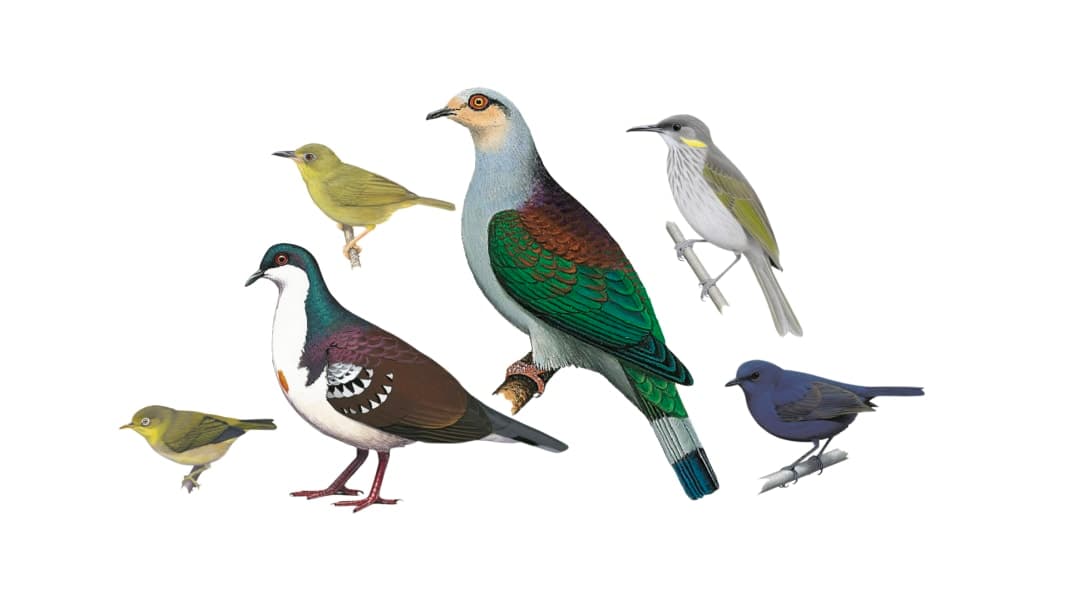
How many birds are getting added to the lost birds list in 2026? Here are the six species coming onto the list this year:
1. Mindoro Bleeding-heart – The only addition to this year’s list that does not have a documented record from 2015, Mindoro Bleeding-heart did not qualify as lost in previous updates because of a 2016 sound recording on xeno-canto. The identification of this recording has recently been questioned, however, which pushes the last definitive documentation of this Critically Endangered pigeon to 2005, when photos were taken of a bird caught by a trapper on Mindoro, Philippines.
2. Mindoro Imperial-Pigeon – Like the bleeding-heart, Mindoro Imperial-Pigeon is also endemic to is namesake island of Mindoro, were it is found in montane forest. The last documented records of the species appear to be photographs taken in 2015 on Mindoro’s Mt Halcon.
3. Guadalcanal Honeyeater– This unique honeyeater is found only in the highlands of Guadalcanal in the Solomon Islands. These highlands are one of the more challenging areas of bird endemism to access in Melanesia, and multiple birds that are endemic to the Guadalcanal highlands have either been lost or only recently photographed for the first time, such as Moustached Kingfisher, Guadalcanal White-eye, and Guadalcanal Fantail. The honeyeater, which was sound recorded in 2015, joins Guadalcanal Thicketbird to make two species from Guadalcanal that are currently lost.
4. Minahasa Shortwing – Sound-recorded in 2015, the Minahasa Shortwing was previously one of a very small number of birds that did not qualify as lost but had never been photographed. It is found only on mountains in the Minahasa Peninsula, in Sulawesi, Indonesia, and is considered a subspecies in the eBird/Clements taxonomy: Great Shortwing (Minahasa). It is the only new addition to this year’s list that has never been photographed.
5. Samoan White-eye – A surprising addition to the list, the Samoan White-eye is endemic to the highlands of Savai’i, Samoa. Older visits to the white-eye’s habitat reported it to be common, but more recent visits have only recorded single individuals and none of these with documentation. The last documented record appears to be sound recordings made in 2015.
6. Vanikoro White-eye – Described as a distinct species in 2008, this white-eye is found only on the remote island of Vanikoro in the southeastern Solomon Islands. It has been described as common on Vanikoro, but very few birders visit the island, and one of the most recent birding groups to go there, in 2017, only briefly encountered a single individual which they were unable to photograph or record. A 2015 sound recording seems to be the last documented record of the species.
These six species mark the lowest number of birds to be added in one of the annual lost bird list updates (nine species were added in 2024, and ten in 2025). For the first time, there are no new lost birds from South America, North America or Africa. Instead all of the new additions occur on islands in or around the Pacific. Considering that the vast majority of bird extinctions occur on islands, it is concerning to see more island species on the lost birds list. Hopefully these new additions are just overlooked and will soon be rediscovered.
How many lost birds are there now?
With five rediscoveries, one extinction and one taxonomic change a total of seven species removed from the Lost Birds list in 2025. Counting the six new lost birds there are 121 lost birds as of January 1, 2026.
For anyone keeping tabs on overall progress, the initial list of lost birds that was published in 2022 included 142 species, that dropped to 126 in 2024, 122 in 2025, and now 121. Will 2026 see more species coming off the list soon?
Updates to the lost bird list are possible thanks to all of you who shared media records of birds on platforms like eBird, Xeno-canto, iNaturalist and more. For this update, Gustavo Bautista and Gustavo Adolfo Carrasco kindly sharing their photos of Sira Tanager, the only documented record of the species in the last decade that we can find. Thank you to Brian Gibbons for tracking down records of Tongan Megapode, another species which nearly qualified as lost. Thanks as well to Mark O’Brien, Rob Hutchinson, James Eaton, Josh Bergmark, and David Ascanio for comments and feedback on selected species and to Marshall Iliff and Denis LePage for aligning annual updates in the eBird and BirdLife Taxonomic Checklists.