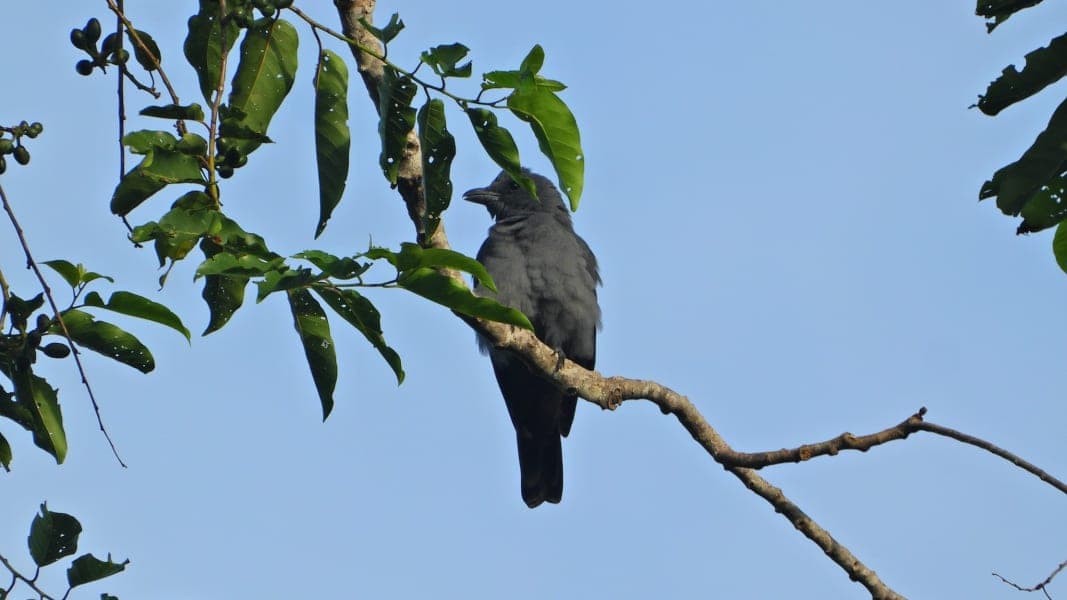
Nina Foster / 16 Mar 2026 / Sulu Cuckooshrike
On November 15, 2025, Shareef Khaddafi Hairal woke up in the mountains of Tawi-Tawi, a remote island province in the Philippines’ Sulu Archipelago. A lifelong resident of the region, wildlife photographer, and former forest ranger, Hairal now works as a surveyor for the Ministry of Environment, Natural Resources, and Energy (MENRE). He had set up camp the night before with a team from MENRE and the Philippines Biodiversity Conservation Foundation, Inc. (PhilBio), including officer Abdulmukim J. Maruji and wildlife researcher Andrew Reintar.
The group was searching for one of the world’s rarest birds: the Sulu Hornbill, a Critically Endangered, range-restricted species whose population is estimated at fewer than 20 pairs. Rapid deforestation and hunting have pushed the bird to the brink of extinction. Early that morning, Hairal and his colleagues were elated to hear the hornbill’s distinctive nasal cackling nearby.
“The group settled within the vicinity of camp. Then, the Sulu Hornbill showed, and you could hear other avifauna, from woodpeckers to imperial-pigeons,” Hairal recalls. With a Nikon P1000, he photographed the vocal visitors. Then, another bird arrived. “Suddenly, this dark bird flew in front of us. I thought it was just another flycatcher, and I took a picture of it,” he adds.
The sleek, sturdy individual was a uniform gray with darker wingtips and tail feathers. Reintar noted the bird’s larger-than-expected size and was intrigued by its coloration. Unsure of the species, the team returned to Tawi-Tawi’s capital, Bongao. Hairal uploaded his images to Facebook, where Philippine bird expert Desmond Allen identified the species. It was the Sulu Cuckooshrike, last documented by Allen himself in 2008. Endemic to the Sulu Archipelago’s lowland and foothill forests, the species had been lost to science for almost two decades.
The species’ IUCN Red List status has not been evaluated because BirdLife International still considers it a subspecies of Bar-bellied Cuckooshrike. eBird taxonomy, following AviList, only recently recognized the bird as a distinct species in 2024. It is such a poorly known taxon that it does not even have an illustration in Birds of the World.
Birding and Bird Conservation in a ‘Do Not Travel’ Zone
Years of political instability and conflict in the Sulu Archipelago helps to explain why no one documented the Sulu Cuckooshrike for nearly 20 years. For decades, the region has been afflicted by armed extremist groups responsible for kidnapping and other attacks, often targeting foreign nationals and local government entities. In 2012, for instance, Dutch birder Ewold Horn was kidnapped by the militant group Abu Sayyaf on his expedition to photograph the birds of Tawi-Tawi. He was held hostage until 2019, when he was shot and killed during a conflict between his captors and the Philippine military.
Such incidents led many countries to issue travel advisories for the Sulu Archipelago and hindered local conservation work. Even today, the U.S. Department of State advises against travel to the islands. In recent years, however, coordinated efforts between local governments and military forces have established a tentative peace, and travel around Tawi-Tawi has become safer for local residents like Hairal and Philippine nationals like Reintar. This improved security has created new opportunities for wildlife conservation, including the rediscovery and monitoring of lost species like the Sulu Cuckooshrike. The bird has already been reported in five eBird checklists from Tawi-Tawi in 2026, a positive sign suggesting that the species is not uncommon in the correct habitat. Hairal is optimistic that the opportunities for birding and bird conservation on Tawi-Tawi will continue to improve in the future.
“With the right coordination with the concerned agencies, I think safety concerns will not pose any barriers or conflicts to birders and other conservationists,” he says.
The Sulu Cuckooshrike is not the only species on the lost birds list to reside in a region with security concerns and difficulties of access. The northeastern Democratic Republic of Congo, which has suffered through repeated armed conflicts in recent years, is home to 10 lost birds including species like Prigogine's Greenbul, last documented in 1979, and Itombwe Owl, last documented in 1996. In Somalia, similar obstacles have contributed to Obbia Lark becoming a lost bird. In Peru, concerns around security have limited access to the montane forest where the Vilcabamba Brushfinch was last recorded in 1968. In cases like these, social realities can be the primary factor in shaping the ability of people to find and record lost birds.
Building Momentum
In the Sulu Archipelago, increased accessibility and the rediscovery of the Sulu Cuckooshrike have given the birding community hope for finding the region’s other lost species, namely the Sulu Jungle Flycatcher and Sulu Bleeding-heart. The Near Threatened Sulu Jungle Flycatcher was last documented in 1998, and the Critically Endangered Sulu Bleeding-heart has been lost for more than a century, and is known from only two known specimens collected in 1891. Hairal will be searching for these species when he begins his second season of biodiversity surveys this March.
PhilBio is also keeping an eye out for the archipelago’s lost birds. The organization reported mist-netting the Sulu Jungle Flycatcher in 2020, although they did not capture photo, video, or audio recordings. They also have faith in the continued existence of the Sulu Bleeding-heart.
“Like most bleeding-hearts, it is a skulking species, naturally rare and solitary. We really hope we can photograph the species or mist-net it,” says Lisa Paguntalan-Marte, PhilBio’s executive director.
Above all, documenting these species fills important knowledge gaps in our understanding of Sulu and Tawi-Tawi’s biodiversity in the face of ongoing habitat loss.
“There is a golden opportunity to contribute to conserving globally threatened species before it is too late,” Paguntalan-Marte reflects. “A significant portion of Tawi-Tawi Island still retains good forest habitat, in relatively good condition despite the historical disturbances. It is just a matter of time before the impacts of land degradation and climate change will further exacerbate the fragile island ecosystem.”
Nina Foster is a science communication specialist with interests in ornithology, forest ecology, and sustainable agriculture. She holds a BA in English literature with a minor in integrative biology from Harvard University and is currently an environmental educator at Schoodic Institute at Acadia National Park.