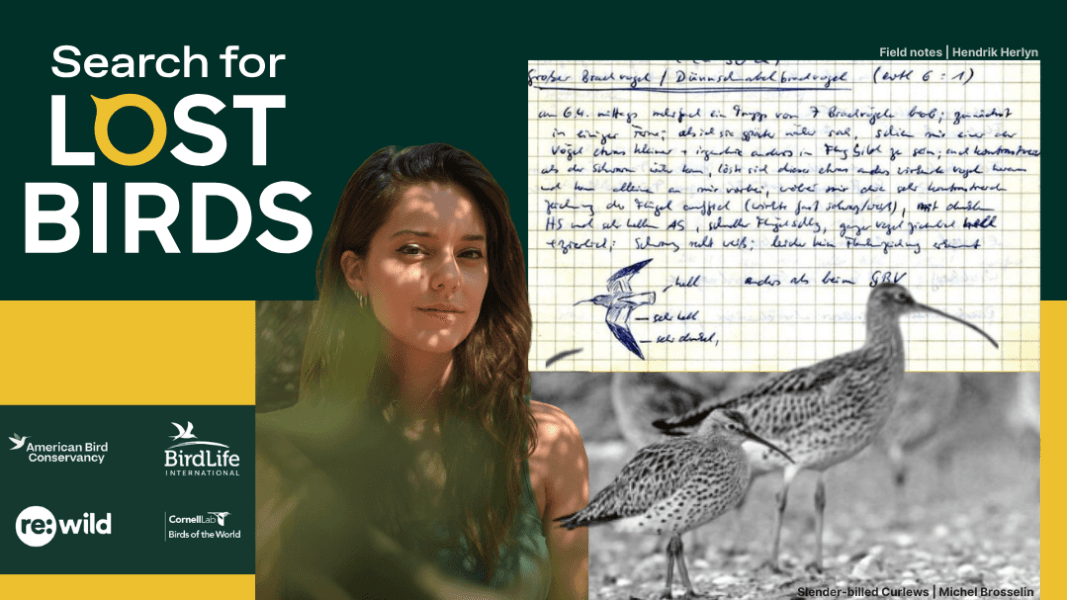
Search for Lost Birds / 23 Mar 2026 / Slender-billed Curlew
An interview with Sara Camnasio about her experiences researching the Slender-billed Curlew in Italy for Echoes in the Land.
In 2025, the Slender-billed Curlew became one of the first species on the lost birds list to be officially declared Extinct (learn about some of other extinct lost birds and the process behind declaring them here). This extinction is recent: The last documented records of the curlew are photos taken in 1995, and there are even videos that we can watch online of this now vanished bird.
What does it mean that the Slender-billed Curlew is gone forever? How should we feel about this?
Sara Camnasio, a researcher, storyteller and National Geographic Explorer, spent six months studying the history of the Slender-billed Curlew in her home country of Italy to create Echoes in the Land, an online cultural memorial that chronicles the bird’s disappearance and explores what the loss of the species means both culturally and ecologically.
Sara caught up with John Mittermeier from the Search for Lost Birds to reflect on her experience studying the curlew and share what she feels we should learn from its disappearance.
How did you become interested in conservation and birds?
My background is in astrophysics and design. I've always been very interdisciplinary and I developed an interest in the intersection of science and design, which is why I often do storytelling projects in conservation.
Birds found me unexpectedly. The first time I visited California I was walking in Muir Woods when I heard a woodpecker drumming. It made me feel fully present in the moment in a way that I'd never experienced before. When I returned home, I joined an outing with the Feminist Bird Club and felt like I had found my people.
I moved to California in 2020 and co-founded the Feminist Bird Club chapter in Sonoma County, creating programs to increase access to birding for historically excluded communities, including a raptor training program for diverse, intergenerational groups. In 2024, I moved back to Italy and I started getting involved in bird conservation here.
When did you first learn about the Slender-billed Curlew? What drew you to the idea of doing a project on it?
I first heard about the Slender-billed Curlew (chiurlottello in Italian) while working on a bird banding project in Ladispoli, on the coast near Rome, one of the last wetlands left in the area. I started researching the bird, and was captivated by the Italian bird community's relationship with it – it’s mythical status, the scattered taxidermy specimens in various museums and institutions around Italy, the 2022 Facebook frenzy when a blogger found a perfectly preserved specimen in a local high school. In Italy, sightings were compared to "Yeti" encounters. The chiurlottello had this mystical air about it. It felt like it existed in the liminal space between presence and extinction, hope and loss. I went to see a specimen in the Zoological Museum in Rome where they had an interactive exhibit where you could hear its call. It was so haunting and sad to hear it. It felt like a solitary call in this era of silences caused by extinction.
For the past few years I have been interested in the concept of "double extinction.” We don't just lose a plant or animal when something goes extinct but also all the cultural knowledge around it. Italy had over 30 regional dialect names for the chiurlottello, such as taragnola, pivirol, and terraiolo. Each name represented a distinct way of knowing that is vanishing with the species. I wanted to create a memorial that serves as both a commemoration and a warning for other similar species that may face the same fate.
What was the experience of researching the curlew? How did you find sources and people to connect with?
The research was deeply multifaceted, working across three critical Italian sites: Lago Salso in Golfo di Manfredonia (Puglia, site of the last Italian sighting in 2000), Comacchio wetlands (Emilia-Romagna), and the Viareggio-Arno river mouth (Tuscany). My collaborator was ornithologist Nicola Baccetti, who authored Italy's action plan for the species. In total, I researched and found over a thousand cultural artifacts connected to the curlew, everything from scientific specimens to literature spanning two centuries to market paintings showing trade networks.
It was extremely difficult to find all this information. I had to interview museum archivists and researchers who sometimes would send me photographs of archival materials that had not been digitized. A lot of cultural information is with people, rather than physical or digital artifacts.
Unfortunately, there are very few people left who even know the chiurlottello existed, so it was hard to find people to interview. Nicola told me that the person who was likely the last hunter to know the chiurlottello's call by heart passed away recently.
Are there things that surprised you about the story of the curlew in Italy?
The sheer density of the bird’s cultural presence surprised me. The number of names alone was not something I expected. It meant that this bird was not rare or obscure in Italian culture. I found over 30 dialect names, market paintings, evidence of a sophisticated taxidermy trade, and specimens in schools that were used as teaching tools. I was also struck by how early warnings about the species were ignored. There were concerns raised in 1912, and explicit extinction warnings by 1943. Yet meaningful conservation didn't begin until 1988. By the time the 1996 action plan was published, the species was likely already extinct.
Any particularly memorable moments from the research experience that stand out?
Reading old hunting journals (from 1800's) made me cry a few times. It's very strange because the writers considered themselves naturalists and nature lovers, and they spoke about these birds with admiration, but then of course they would hunt and kill them. There was one journal entry that I feature in the online memorial that narrated a sighting of hundreds of Slender-billed Curlews – something unimaginable today – said how beautiful the birds were, and then proceeded to describe how disappointed the writer was that they were not able to kill any of them. It's heart-breaking to read about such abundance and how it was taken for granted.
Your maps demonstrating the loss of wetland habitat in Italy are striking. How did you find these maps and learn about the loss of wetlands?
I learned about the wetland changes from the many conservation papers written about the Slender-billed Curlew, especially in the national conservation plan. I also spoke with Nicola, who is one of the authors of the plan, who confirmed what the most impacted areas were. I focused on three critical sites and started to look at satellite data from present day and I got the idea that it would be really powerful if I could find historical data showing the original wetlands. I then combined historical maps, archival photographs, and scientific literature documenting 19th and 20th century drainage and agricultural conversion. You can see where the bird occurred and how those landscapes transformed over centuries.
You describe how the disappearance of Slender-billed Curlew connects to other lost species and to population declines for shorebirds around the world. After studying the curlew, are you optimistic about the future for other shorebirds? What can people do to help them?
I'm both sobered and cautiously hopeful. Five of eight Numenius species are currently of conservation concern and species like the Eskimo Curlew is Critically Endangered (Possibly Extinct). But we now have resources that previous generations didn't, things like satellite tracking, habitat modeling, citizen science networks like eBird, better international conservation frameworks and collaboration projects, and in general more consciousness about the damages of unregulated hunting and dramatic habitat changes.
A few things I found that people can do to help:
Support wetland conservation and restoration at all scales by either volunteering in local projects or donating;
Participate in citizen science through things like eBird and waterbird counts, your data contributions can help understand if bird populations are declining over time;
Advocate for flyway-scale bird protection across borders;
Learn about the local and historical names of birds, also check out https://birdnamesforbirds.wordpress.com/ for an interesting deep dive on the topic of social justice and bird names;
Support agricultural policies to maintain wetlands and grasslands.
What do you hope people take away from the extinction story of the Slender-billed Curlew?
I hope people understand that extinction is not just an ecological loss, it's also a cultural one and a deeply human one. When the last Slender-billed Curlew disappeared, we lost names connecting Italian communities to seasonal cycles, wetlands, and their own histories. Ecological loss and cultural loss form a feedback loop. As a species declines, people start forgetting about it, the names fade, the stories stop being told, the connections weaken and that cultural forgetting accelerates the ecological disappearance.
The Slender-billed Curlew teaches us we cannot take species for granted even when they are abundant. The cultural evidence shows this bird was once woven into Italian life, yet it rapidly declined until it disappeared entirely. When we lose a species, we lose part of ourselves and our culture. Cultural forgetting and ecological loss are inseparable. Recognizing that connection might be what helps save the species that remain.